Meant to Sing
From the Community
By Gabriela Ramirez-Guevara
Quechua is often defined in textbooks as a ‘family of Amerindian languages spoken across the Andes.’ But for me, it is not an abstract category or a relic in danger of disappearing. It is the language of my mother. She calls me wawa—not ‘baby,’ not bebé (in Spanish), but wawa. There is a softness in that word, a whole world contained in its sound.
My connection to Quechua is not rooted in a village where I grew up speaking it daily, but in my family’s bloodline. It is the voice of my mother, passed down from my grandmother, a living thread I am now learning to weave myself. This inheritance drives me to create Toqto London, a space dedicated to incentivising Andean music and artists, ensuring that this language finds its home in the heart of the city. Here, Quechua is not something to be preserved at a distance in a museum; it is lived, spoken, and carried in the everyday gestures of a community we are building. The fact that it is still alive moves me—not out of nostalgia, but because it holds both the tenderness and the strength of the people who speak it, and the people who are choosing to bring it forward.
Quechua carries a history. Long before it was written about, it moved across the Andes as a language of exchange, memory, and community, later becoming central to the Inca world. Even after the violence of colonisation, it endured, spoken in homes, in markets, in the quiet continuity of everyday life. Writers like José María Arguedas understood this not as survival alone, but as a form of resistance: a language that refuses to disappear because it is still needed, still felt.
The language is also carried through song. Traditional songs hold history, but also a way of relating to people, to nature (Pachamama), and to what exists beyond it and how it is understood. Meaning is not separate from sound, voice, or rhythm; it is bound to them, existing through them rather than apart from them.
Erai erai pampachapi / pares pares palomintay
Alanhuan laqyanacuchkan / Pukinqa tupananuchkan
Chaypi punis kuyanakuy / chaypi punis wayllunakuy
Translation:
In the centre of the threshing floor,
pairs of little doves flap their wings (tossing playful blows),
and with their beaks they touch one another…
right there, there is love, right there, there is love,
right there, they love each other tenderly.
In this sense, Quechua is preserved not only through speech but also through forms that continue to organise how life is understood and shared.
And yet, a language that holds such tenderness can still be made to feel like a source of shame. This is a widespread reality across the Latin American continent, affecting communities whether they remain in their rural homelands or navigate the monstrous cities that dominate the region. In both spaces, indigenous traces, brown skin, rural accents, and surnames are often met with ridicule, pressuring those who speak to fall silent.
Children learn to hide their mothers’ voices; they stop answering when called wawa. Adults mute their accents to avoid being marked as ‘backward.’ This is not a natural fading of culture, but a hierarchy imposed by a society that equates ‘progress’ with whiteness. Yet Quechua does not beg for recognition. It beats on in homes, in markets, in the songs that carry history across generations. The injustice is not that the language is fragile, but that it is denied its rightful place in the public sphere, forced to whisper when it was meant to sing.
The issue is not only about losing a language. In many places where Quechua is spoken, it is still treated as less legitimate than Spanish, associated with lower social status, and at times met with racism. The problem is not disappearance alone, but the way it is often excluded from public and formal spaces, schools, institutions, and also cultural stages like concert halls. Language survives in everyday life, but its presence is not always recognised or given equal visibility. In that sense, the question is not only preservation, but who gets to be heard, and where.
So why does Quechua belong on an international stage? Not because it needs permission to be there, and not because inclusion is a favour granted by cultural institutions. It belongs there because the world grows richer when it is heard.
Quechua holds a way of understanding that has nourished communities for millennia, a way of relating to the earth not as resource but as Pachamama, not as ownership but as ayni, reciprocity. A way of knowing that meaning is not extracted from the world but shared with it, through sound, through voice, through the act of singing together. And at the heart of this way of understanding lies ayllu, community, not as a loose association of individuals, but as a web of mutual responsibility and belonging. These are not exotic curiosities; they are living answers to disconnection, to extraction, to what gets lost when a single way of seeing the world is allowed to dominate.
It is not a common or easy path, but some Indigenous musicians are bringing their languages into contemporary music. By blending their native languages with modern styles, they give them another life, carrying them into new spaces of visibility, including stages like La Línea Festival in London.
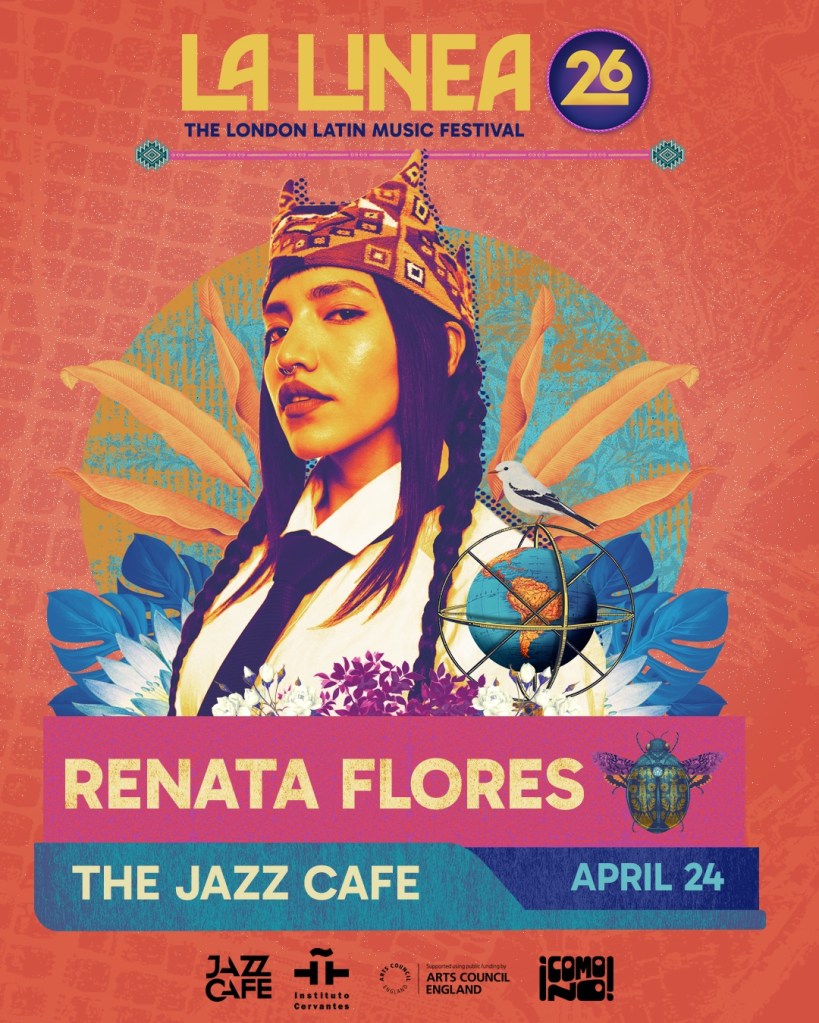
Renata Flores is part of this movement, her voice rising within it. When she covered the Rolling Stones’ “Satisfaction” in Quechua, Rolling Stone called it a “declaration that Quechua belongs on the same stage as rock and roll legends.” The Guardian noted she refuses to be “boxed into folklore,” instead injecting the “softness of her grandmother’s voice” with the energy of modern R&B. And NPR Music recognised her as the artist “pushing indigenous languages to the centre,” proving they are “living, breathing engines of contemporary culture.”
Her original song “Qam Hina” captures this spirit of hope and possibility. Here is a fragment:
Munani pukllayta, munani musquyta, munani asiyta, munani yachayta, munani rimayta, munani takiyta, munani pukllayta, munani musquyta, qam hina.
Translation:
I want to play, I want to dream, I want to laugh, I want to study, I want to speak, I want to sing, I want to play, I want to dream, just like you.
Listen here: https://youtu.be/UGkyV2G7hGE?si=KLFhOFneAxBQsn4P
There is no hesitation here. The repetition of munani—”I want”—is a rhythmic declaration of rights. It is a child claiming the fundamental freedoms to learn, to laugh, and to create, voiced with absolute clarity through Renata’s modern sound. By bringing this fusion to London, Flores carries the AYLLU with her. She turns a language once silenced into a headline act, proving that Quechua is not a relic of the past, but a vital, modern force for the future.